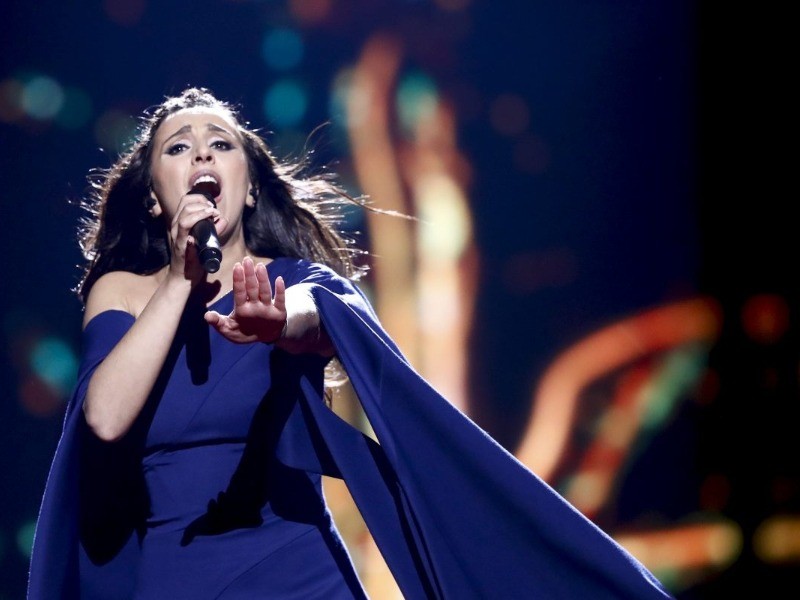
The Wiwi Jury — our in-house panel of music unprofessionals — are re-assembling to celebrate the 2010s. Today we stop by Ukraine, to discuss the dark and emotionally-charged “1944″ by Jamala.
One of the more lyrically-controversial entries in the list, the raw and vulnerable energy of “1944” stunned people when it was entered into Ukraine’s national selection. There it stormed to victory, to represent Ukraine at Eurovision. Still fresh from political tensions in the area, the brutal and thought-provoking themes of the song resonated across the whole continent. The staging captivated audiences when paired with an iconic moment where a golden tree burst out of Jamala to signify hope and rebirth.
Things were tense during the Eurovision 2016 voting, the first with the new system that wouldn’t reveal the winner until the very end. Viewers didn’t yet know that Ukraine had beaten televote winner Russia’s Sergey Lazarev until the very last second. Do the Jury still think this was the right result in arguably one of the toughest years of the decade?
Jamala – “1944”
“1944” reviews
William: This is dark, direct and at times nihilistic: “They kill you all and say, ‘We’re not guilty’…everyone dies.” In lesser hands this would come off as melodrama. But Jamala delivered it with conviction and soul, resulting in a strangely intoxicating and other-worldly sound. “1944” defied convention, mixing traditional Crimean Tartar music with soul and R&B, and yet it somehow remained universal and accessible. At the end of the song she channelled the pain of a thousand victims in one single cry. This is a gift that can’t be taught. Throw in that magical tree moment and it’s no wonder this won against some very stiff competition.
Score: 9/10
Lucy: When “1944” was first chosen to represent Ukraine in 2016, I was unsure due to certain themes in the song, but once I saw the live performance I was sold. The emotion in her call, just before the last choruses broke me and made me pick up and vote a whole bunch of times, and the dark moody instrumental in the verses really honed in on the bleak situation the song is referring to. Relevant, brave, heart-breaking. I adore Jamala, and couldn’t have been happier with her victory. Oh, and the tree deserves a mention surely? THE TREE.
Score: 9.5/10
Calvin: I have no words for this song and performance. Everything is simply perfect. It feels like I’m taken out of the contest and into a Jamala concert. The tree of life might be the best visual we have ever seen in the contest. This song, performance and message are so much bigger than Eurovision and I’m glad that many people understood it. In contrast to many other entries, her performance aged very well and I feel the same intensity of emotions today as on the night of the final.
Score: 10/10
Edd: The true merit of “1944” is its uniqueness: The beat, the instruments, the topic, the Crimean Tatar Language, the vocal tricks, even the song title itself. The lyrics are dark and impactful, yet the staging is beautiful and simplistic. Jamala’s voice is not only unique but also highly powerful, and she gives one of the most sincere and moving Eurovision performances in history. Although it’s not the most appealing song to listen to, its meaning and Ukraine’s political situation at the time helped make the performance be so impactful.
Score: 7.5/10
Steinunn: At first I wasn’t so sure about the quality of this song. Yes, it was dramatic and emotional but there was something missing for me. Then Jamala entered the stage. I still remember the goosebumps I got when seeing this performance on stage for the first time — and that was just a rehearsal. The story behind the song is conveyed in a perfect emotional way by Jamala and it doesn’t matter at all that you don’t understand half of the lyrics. In this case words are not necessary, the sentimental elements are what matters.
Score: 9/10
Katie: I have nothing but respect for the way Jamala was so unapologetically herself at Eurovision 2016. She was firm in her convictions about 1944’s message and she showcased her Crimean Tartar culture proudly to an international audience. This is one of my favourite things about Eurovision and why I believe it is a really valuable platform, so I’m happy that Ukraine chose to send this entry and that it faired so well. Let’s not forget Jamala’s staging and the stunning light display that Eurovision artists still draw influence from. In hindsight, though I don’t think 1944 is a memorable winner like “Heroes”, which we heard again in Tel Aviv, Jamala’s performance was nonetheless iconic.
Score: 7/10
In the Wiwi Jury we have 24 jurors but only have room for six reviews. The remaining scores are below:
| Antranig: 10/10
Pablo: 8.5/10 Robyn: 7/10 Angus: 4/10 Sebastian: 7.5/10 Jonathan: 10/10 Bernardo: 7/10 Deban: 8.5/10 Luis: 9.5/10 |
Oliver: 8.5/10
Kristin: 6.5/10 Lukas: 7/10 Barnabas: 4/10 Florian: 6/10 Natalie: 10/10 Julian: 10/10 Tom: 5/10 Charlotte: 5/10 |
We have removed the highest and lowest scores prior to calculating the average. This is to remove outliers and potential bias. We have removed a low of 4 and a high of 10.
Wiwi Jury verdict: 7.82/10
What do you think of this song? Share your own score and review below!

If I were to use one word to describe this song it would be “haunting”, I remember when I listened to it and even though I did not particularly like it, I felt shivers all over my spine, it was so dark and “out there”, and something told me to listen to it over and over and over again until I became obssesed.
Thank goodness this won instead of Sound of Silence
My most favourite song of all times! I’m listening to it all the time!
Can someone please remind me what Jamala said about the meaning of the tree? I forgot it and couldn’t find it myself
As i remember the tree is a symbol of new life for Crimean Tatar folk
Thanks 🙂
I also found a Wiwibloggs article saying it’s a symbol of growth and a new beginning
Perhaps Jamala said so somewhen
Musically one of my favourite ever “Reprise” moments at Eurovision happened in “1944”. But it is far from being a happy moment, as the song is dramatic and powerful. In Eurovision I personally enjoyed using it to get away from our troubles in real life, yet here Jamala was using Eurovision to highlight our problems instead. One could say that this song marked the beginning of the end of Eurovision’s fantasy universe. From here on, reality arrived.
I compare it to an art movie that I enjoyed, respected, thought it’s relevant and deserved praise and awards, but haven’t loved enough to feel the need of watching again. Along with “Amar Pelos Dois” it sends a great message for future Eurovision acts: you don’t need to aim on entertainment and be radiofriendly to win. It’s personal (some may say too personal), contemporary, has authentic local flavor and the execution was perfect. In a year I hadn’t found an entry to love deeply (“Lighthouse” tanked), it was a fair winner to me.
With me is the opposite, the way I feel about “APD” is the way you feel about “1944”. But the interesting thing is that many people love both, even if they’re so different from each other and from what we usually expect from an Eurovision song. Kudos to Jamala and Salvador, who were able to capture people’s attention with their magnetic presences.
I compare it to an art movie that I enjoyed, respected, thought it’s relevant and deserved praise and awards, but haven’t loved enough to feel the need of watching again. Along with “Amar Pelos Dois” it sends a great message for future Eurovision acts: you don’t need to aim on entertainment and be radiofriendly to win. It’s personal (some may say too personal), contemporary, has authentic local flavor and the execution was perfect. In a year I hadn’t found an entry to love deeply (“Lighthouse” tanked), it was a fair winner to me.
Such a BS this
yeah nothin bad u can say bout this song….. it’s just that good
Simply MASTERPIECE! One of the best song of Eurovision history, heartbroken and incredibly powerful composition… Still gives me a goosebumps…
I never liked this song. I didn’t like Australia. I didn’t like Russia. I honestly wanted France to get the trophy on 2016
I appreciate the effort you put into these posts, but I don’t think you’re right with your approach to outliers. In the case when multiple people give a song 10 points, and many others 8 or a 9, 10 is not an outlier. I would argue only something like 1 to 3 points would be. There are some statistical methods to calculate outliers, but I don’t think it’s really necessary in calculating your score in this case, unless someone is obviously trolling by giving a Eurovision winner 1 point.
Seriously, it was an amazing performance and gave the very definition of a “Eurovision Moment”. I think once everybody saw the rehearsal, we knew that this was going to be the winner (despite the juries and their, quite frankly, bizarre voting this year).
The only sticking point is really, how much is this a song that somebody would listen to without the performance? Does a deserving Eurovision winner *need* to stand alone as an piece of audio?
Yes. For example, I Wanna. Trash.
I remember calling this a darkhorse. I liked it but I was unsure if this would have a chance to even get a decent placing because of the themes that “1944” carries as a song. Much to my surprise when finale night came, and the live performance resonated well enough to be strong contender for this win.
This is one of the best winners of the recent years and the best Ukranian entry overall.
Excellent production.. the duduk, Jamala’s voice filled with pain, the Crimean Tatar language, and of course that marvelous staging.
She deserved the victory!! 10/10
One of the most haunting moments of ESC history, and a real gem of a song. A deserved winner even in such a tough year.
It’s not something that I can listen to over and over, but it’s definitely a deserving winner. Surely even people who don’t like the song can appreciate the emotion, the talent, the staging – 10/10 from me too. It’s the first winner to be written and performed by a woman too, so extra points for feminist credentials…
First time I ever agreed with Antranig! My clear, not-even-close winner of 2016 and one of my favorite winners ever. It and “Amar pelos dois” were the one-two slap in the face to the reductionist idea that Eurovision can’t ever be legit. The staging, vocals, lyrics, and overall message of “1944” are exemplary and transporting. It may be polarizing, but I always found it a very deserving winner and one of the best songs in the history of the contest. 10/10.
Weren’t you Serhat’s biggest supporter? 🙂
THIS year, yes. Didn’t even have Ukraine to worry about this year! I Didn’t Know isn’t as good as Say Na Na Na, so I’m less surprised that they didn’t make it in that year. But it is still a lot of fun, and I was delighted to see him make a comeback.
Best winner of the decade.
Sorry but I cannot understand what other people are hearing. I totally agree with Angus. Around 4 out of 10 is about right for this song. I don’t like the sound of her vocals. I cannot put my finger on the reason but her voice just annoys me. Along with Netta this is my least favourite winner of recent years. Considering this is a non political contest I do think this song was very lucky to get past the adjudicators.
PC police will not understand what deportation means. People received houses for free in a new place. Today you are at the mercy of the banks. Cry for yourself.
Downvote, you really don’t understand that Jamala’s family still lives in Crimea and it’s happy. You don’t know the difference between deportation and genocide. They were deported, they had free houses from the government, something you will never have.
People she sings about had just 15 minutes to leave their homes with guns pointed at them, not knowing what’s gonna happen to them. Then for weeks they were trapped in railcars with almost no food and water, many many died or were killed during that time (from 40 to 100 thousand people). Then they were forced to do slave works in harsh environment, many of their human rights were denied, and they had to face rude treatement from the Uzbek people. Say what you will, but that’s just ignorance, and you’re probably just a troll. Also, Jamala’s family returned… Read more »
Jamala was literally born in Kyrgyzstan as a direct result of this deportation. Unlike other ethnic minorities deported from their homelands in the aftermath of WWII, Crimean Tatars were barred BY LAW from returning to Crimea until the collapse of the Soviet Union. The Soviets did everything they could to erase their identity, from Russifying their language and names of their villages and cities, destroying their monuments and art, to downright removing “Crimean Tatar” as a choice from the Soviet census post-deportation. It was, in all meanings of the word, a genocide. Unfortunately, it was partially successful as there are… Read more »
Haunting and powerful, this really deserved to win and is a great example of how Eurovision can deliver really interesting and unique songs and performers. My one gripe was that I preferred her interpretation from the selection shows. She was a little more controlled where as in the final her emotions took over too much. A small point, because it really was fabulous.
Also: If we’re being honest, the real title of this song is “2014”. She made that abundantly clear with her outburst in this year’s Ukrainian NF. Just keeping it real.
That may be true, but even if it is…so what? It may be against the rules of the contest, but it’s no reflection on the quality of the song. If anything, it’s all the more admirable how she echoes the past against the present. Art!
So I have the right to point out the hypocrisy. Why didn’t the EBU allow Georgia to participate in 2009 then? Double standards galore. And I already commented on the song. Obviously, the majority of commentators here have the opposite view and that’s alright. Frankly, I am even more genuinely baffled so many people can seem to listen to this and enjoy it. It’s beyond me, I find it so awful. But that’s alright, too. Also, there was nobody in the top 3 for me that year that i wanted to win, so that makes it even more alright. lol
She was out of place, indeed, but let’s not deny the fact that such a question will certainly raised, the same way one certain French tried riling up tensions between Armenia and Azerbaijan with his own set of “uncomfortable questions” in 2016.
Absolutely no. Russia should have won. This should not have been allowed to compete, since it’s a political song. So 2/10
I have to agree. Not sure what people see or hear that I don’t.
Sergey’s song was very old fashioned. It deserved bottom 5. 1944 has meaningful lyrics and a modern sound and it did not need an over the top production to do well in the voting!
Like”Waterloo” should not have won because it touched on the Napoleonic Wars?
My personal highlight was the tree. The song itself is delivered with emotions, and I respect the topic, but musically it was not that memorable for me. 7.5/10.
2016, 2017 and 2018 were the worst winners ever. But of course everyone will judge me, the most of people are not able to respect other opinions. How sad.
They were the most different, at least 2016 and 2017. I didn’t like “Amar pelos dois” or “Toy” tbh. But those three were among the best in their respective years. I guess you like pop and the most popular music trending in Spotify though, There’s a full range of colors for everyone, but people were tired of classic pop songs winning. That’s all.
2016 and 2018 agree, 2017 was stunning and beautiful to me
Same here. The bland and trite Azerbaijan 2011 sounds downright merciful compared to it.
I never liked this and felt no connection to the melody at all. I didn’t buy into the admiration it had received before the contest and was stunned when it won, even though it had to be expected. Actually much like Austria 2014, but at least in that case, I got the appeal of the song. I would chalk it up to people lobbying for her message and having anti-Russian sentiments, only that can’t be entirely true, either, since Russia won the televoting and the Russian song had no appeal to me, either. Maybe it simply happened because no other… Read more »
For me 1944 is very emotional song…when I’m listening to 1944 I can understand the pain of it. Jamala has incredible voice…for me one of the best voices in Eurovision…but very sad is that this pain is still in the beautiful Ukraine… a lot of people still feel big pain in Ukraine…for me Ukraine is one of the best countries in Eurovision…the only thing I wish Ukraine is to stop the war in Donbas…connect Crimea back to Ukraine and make people happy again 🙂 …all my love from the Czech Republic go to Ukraine 😉
Probably the best song ever performed at Eurovision. I don’t even know where to start – brilliant instrumentation combining quick house beat with traditional sounds, letting Jamala’s jazzy vocals shine, but still audible enough to make an impact on its own and build one of a kind atmosphere, disturbing lyrics – a memorial for all the Tatars that were forced to leave their land, an emotional portrayal of those horrific events, full of doubt, loneliness, sorrow, confusion and pain, a song about destroyed youth and loss of innocence, adressed to Jamala’s great-grandmother, and most importantly a call for peace in… Read more »
Definition of bringing politics into ESC. And it won.
True, but better bad european song than Australia.
This was portrayed PERFECTLY in Stockholm. The raw vocals from Jamala delivered with genuine emotion, the stunning backdrop (the moment with the tree was honestly the moment that Jamala won the contest) and everything surrounding it, this is by far the best entry in 2016 and the best Ukrainian entry ever in the contest, which is saying something because Ukraine is my favourite country in Eurovision. Deserved winner in every sense of the word.
10/10
I must admit I didn’t really connect with this song. There is no doubting the vocal qualities of Jamala and the visual was stunning but I didn’t get the universality of the message and I was surprised that it won. I hate to say it but I also found it a bit over-dramatic.
This is my favorite winning song of the 2010’s (followed by ‘only teardrops’). I once showed a friend, who does not follow Eurovision, Jamala’s grand final performance, and he burst into tears. I think that was what was magical about ‘1944’: irrespective of the language barrier, you could understand and feel every moment and emotion of the song. I mean as a South African, I had no clue that Crimean Tatar was even a language, but when you listened to this song, you instantly got the message. The staging just added to an already powerful song. It’s obviously not going… Read more »